Multi-Agent vs Single-Agent AI for Validation
By marcus-chen | 2026-01-29
Learn the critical differences between multi-agent and single-agent AI systems and why it matters for startup validation.
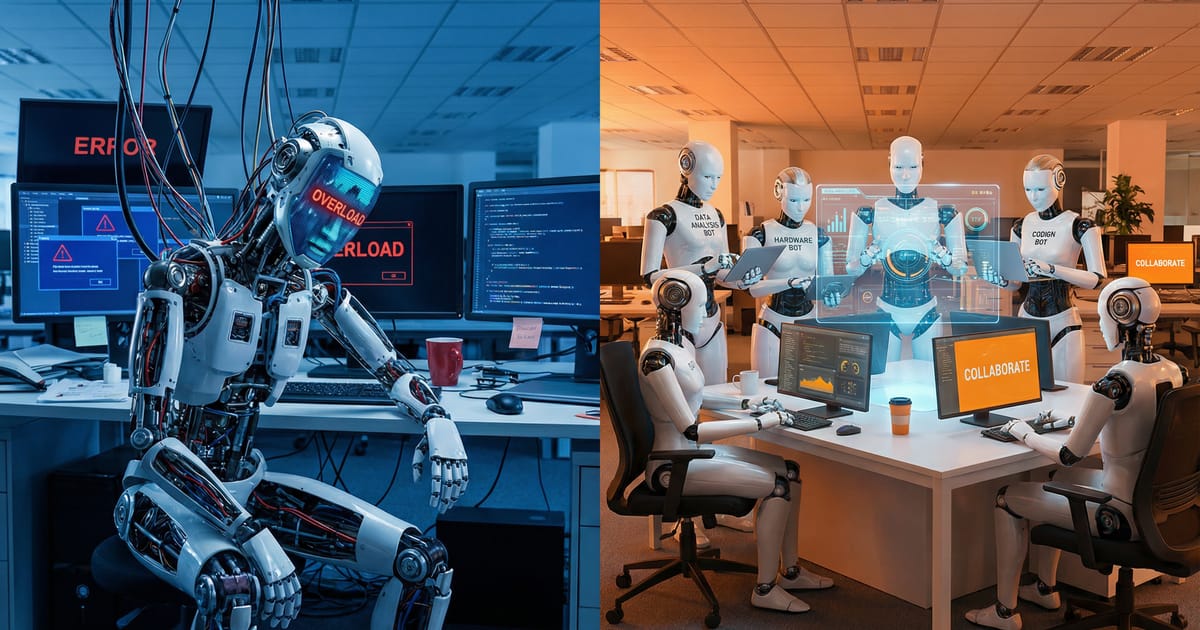
> TL;DR: Single agent AI tools like ChatGPT are prone to optimism bias and lack the specialization needed for rigorous validation. Multi-agent AI systems use teams of domain specific agents that collaborate, debate, and challenge each other's assumptions. For high stakes decisions like whether to build a startup, multi-agent validation delivers the depth, accuracy, and objectivity that single models simply cannot match.
The rise of large language models (LLMs) like GPT-4 has put powerful AI in the hands of every founder. But using a generic, single-agent AI for a specialized task like product validation is like using a Swiss Army knife for brain surgery. It might work, but you're not getting the precision, depth, or safety you need.
To truly de-risk your startup idea, you need to understand the fundamental difference between multi-agent vs. single-agent AI systems. It's a distinction that can mean the difference between a validated business and a failed product. According to CB Insights research, the number one reason startups fail is building products without proper market validation.
Multi-Agent vs Single-Agent AI: Understanding the Basics
A single-agent AI system is what most people think of when they think of AI today. It's a single, monolithic model (like ChatGPT) that takes an input and produces an output. It has a broad range of knowledge and can perform a wide variety of tasks, from writing a poem to generating code.
Think of it as a brilliant generalist. It knows a little bit about everything. For product validation, you might ask it, "Is my idea for a dog-walking app good?" It will search its vast knowledge base and give you a plausible-sounding answer based on patterns it has seen before.The Limitations of a Single-Agent System
- Lack of Specialization: A generalist model doesn't have the deep, domain-specific expertise of a market researcher, a UX designer, or a financial analyst.
- Optimism Bias: These models are designed to be helpful and agreeable. They are prone to "hallucinating" positive feedback and avoiding critical or negative analysis.
- No Adversarial Process: A single agent cannot effectively challenge its own assumptions. It follows a linear path from prompt to answer, without the crucial debate and critique that leads to robust conclusions. As Gartner's AI research indicates, adversarial validation is essential for production AI reliability.
What is a Multi-Agent AI System?
A multi-agent AI system is a collection of specialized, autonomous agents that work together to solve a complex problem. Each agent has its own unique role, knowledge base, and set of skills. They can communicate, collaborate, and even disagree with each other.
Think of it as a team of expert specialists. Instead of one generalist, you have a market researcher, a competitor analyst, a financial modeler, and a UX strategist all working on your problem simultaneously.The Power of a Multi-Agent System for Validation
If you want to understand the technical architecture behind these systems, we wrote a detailed guide on how we built a multi-agent system for product validation.
- Deep Specialization: Each agent is an expert in its domain. The Market Research Agent is trained on market data. The UX Research Agent is trained on usability heuristics. This leads to a much more accurate and nuanced analysis.
- Adversarial by Design: The system is built for debate. The "Skeptic Agent" might challenge the "Optimist Agent's" market size projections. The "Risk Assessment Agent" might point out a flaw in the "Technical Feasibility Agent's" plan. This adversarial process is critical for uncovering blind spots.
- Emergent Intelligence: The whole is greater than the sum of its parts. The interactions between the agents can lead to insights that no single agent could have discovered on its own. This is known as emergent intelligence, and it's the key to a truly comprehensive validation. Harvard Business Review notes that collaborative AI systems consistently outperform individual models on complex analytical tasks.
Multi-Agent vs. Single-Agent AI: Head-to-Head Comparison
When to Use Each Type of AI
In the multi-agent vs single-agent AI debate, it's not that one is "better" than the other; they are designed for different purposes. Knowing when to use each is key to an effective validation process.
- Use a Single-Agent AI for:
* Initial brainstorming and idea generation.
* Writing first drafts of marketing copy or blog posts.
* Summarizing articles or research papers.
- Use a Multi-Agent AI for:
* Comprehensive market and competitor analysis.
* Financial modeling and unit economics stress-testing.
* Identifying hidden risks and opportunities.
* Making high-stakes decisions, like whether to build a product or pivot.
Final Thoughts on Multi-Agent vs Single-Agent AI
The era of relying on a single AI's opinion is over. The future of product validation, and all complex knowledge work, lies in collaborative, multi-agent systems.
When comparing multi-agent vs single-agent AI, the evidence is clear: specialized agent teams provide a level of depth, accuracy, and objectivity that single models simply cannot match. They move beyond simple answers to provide comprehensive, actionable strategies.
So the next time you have a startup idea, don't just ask a single AI if it's good. Put it to the test with a team of them. For a side-by-side look at how the top platforms stack up on architecture, accuracy, and depth, see our startup validation tools comparison. To see what a real multi-agent research team looks like in practice, explore our detailed breakdown of the AI research team powering Valid8's validation engine.
Start Your Validation
Experience the difference a multi-agent system makes. Submit your startup idea and let six specialized AI agents stress-test it from every angle, delivering insights no single model can match.
Start Your Validation and get your report in 24 hours.Why Valid8 Runs This Analysis Better
The multi-agent vs single-agent debate is not theoretical for Valid8. It is the core architectural decision behind every analysis we produce. While single model tools give you one perspective, Valid8 delivers six adversarial perspectives that challenge each other before reaching your report.
- Specialization over generalization: Each of Valid8's six agents is an expert in one domain (market research, competitor analysis, UX, technical feasibility, financial modeling, strategy). A single model spreading itself across all six domains cannot match the depth that dedicated specialists achieve
- Adversarial debate, not agreeable output: Valid8's agents are programmed to critique, not to please. The Skeptic agent attacks the Optimist's projections. The Risk agent challenges the Market agent's assumptions. This structured debate eliminates the optimism bias that makes single model validation unreliable for high stakes decisions
- Emergent intelligence from collaboration: The most valuable insights surface at the intersection of different analyses, where a market trend meets a competitor gap meets a technical opportunity. Single models cannot produce emergent insights because there is no collaboration happening
Frequently Asked Questions
What is the main difference between multi-agent and single-agent AI systems?
The fundamental difference lies in architecture and process. A single-agent AI is one generalist model that produces linear responses, while a multi-agent AI system is a collection of specialized agents that collaborate, debate, and reach consensus. Single-agent systems are prone to optimism bias and hallucinations, whereas multi-agent systems use adversarial cross-examination to produce more accurate, validated insights.
Why is multi-agent AI better for product validation than ChatGPT?
Multi-agent AI for product validation offers three critical advantages: deep specialization (each agent is an expert in market research, UX, finance, etc.), adversarial process (agents challenge each other's assumptions), and structured outputs (financial models, risk matrices, strategic roadmaps). ChatGPT and similar single-agent tools lack these capabilities, making them suitable for brainstorming but not for high-stakes validation decisions.
What are the benefits of multi-agent systems for startup founders?
The benefits of multi-agent systems for founders include reduced risk of building the wrong product, data-driven insights from multiple expert perspectives, identification of blind spots through adversarial debate, and actionable deliverables like financial models and go-to-market strategies. Multi-agent validation transforms vague "viability scores" into comprehensive strategic analysis that informs real business decisions.
Can single-agent AI be trusted for startup validation?
Single-agent AI should not be the sole basis for major business decisions. These models are prone to hallucinations, optimism bias, and lack the adversarial process needed for robust conclusions. They are useful for initial brainstorming and filtering obviously bad ideas, but comprehensive validation requires the cross-validation and specialized analysis that only multi-agent systems provide.
How do multi-agent validation systems eliminate AI bias?
Multi-agent systems eliminate AI bias through three mechanisms: specialization (agents are trained with specific critical directives), adversarial design (a Skeptic Agent challenges optimistic projections), and consensus requirements (findings must be verified by multiple independent agents). This architecture ensures that no single agent's biases dominate the final output, producing more objective and reliable validation reports.
---
Experience the power of collaborative AI. See how our 6-agent validation system can give you a deeper, more accurate analysis of your startup idea.